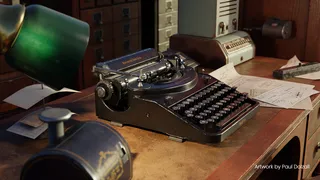
Joachim Bornemann is a one of a kind 3D artist. He specialized in modeling string musical instruments and computer components among many other things. All his marvelous work is shared for free in the collective spirit of Blender. In the interview, he talks about his ideology and creative process.

Hi Joachim, would you please tell us a little about yourself?
I was born in Hamburg, Germany, in 1967 and I still live here. As a young person, I learned how to build tiled stoves and air heating systems and later trained in the field of microelectronics. In the last several years, I have been receiving a small early pension, which makes me somewhat financially independent and gives me artistic freedom.
What attracted you to 3D modeling?
When I was young, I did a lot of electronic experiments and built electronic devices, so it was always important to label front panels, switches, LEDs and connections well. About 6 years ago I discovered the 3D text area in Photoshop and was immediately interested. A friend of mine, who is a graphic designer, introduced me to various 3D softwares that I could try for free. I then wanted to do character animation and was looking for the best rigging software. This is how I came across Blenrig and Blender. I started with Blenrig 5, by Juan Pablo Bouza, which is terrific. Everything, including the suppository in the throat, the pupils and the toes could be animated. Because of that I chose Blender. It is a colossal software, so huge and complex, that it is spontaneously intimidating.

How did you learn to model?
Modeling was difficult to learn. The friendship with the graphic designer didn't last long, so I was alone in front of Blender. I started with the classical donut tutorial from Blender Guru on YouTube. Apart from various tutorials on YouTube, I had no training in graphic design. I learned most of it through experimentation and common sense. I've been doing 3D work for 6 years now and I'm still learning new things. Many things are needed so rarely that they are erased from memory and have to be relearned. I try to do at least 5 sets of each exercise. This consolidates your knowledge of Blender enormously.
You have uploaded to BlenderKit many models of guitars and other musical instruments. What interests you about modeling instruments?
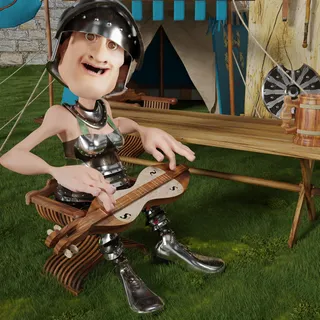
It all started with my comic character, Berta or Bertram. He was supposed to become a knight, which requires to maintain the dignity of knighthood through winning a battle. I modeled some medieval weapons and armors. However, the brutality of that age is too extreme. Therefore, I decided that my character will be a so-called “weichei", a softy, who takes refuge in music making. This is how I came into modeling my first musical instrument, a dulcimer adapted to the middle ages. It awakened my passion for string instruments. I can’t make music, but I can draw. My goal is to model about 100 musical instruments in order to create a string instruments museum in 3D.
Plenty of your models are not just musical instruments, but are also very unique art works. Where do you find all those rare designs?
I find them on the web through regular search and general interest in art and culture. Some things are so interesting that it is simply worthwhile to display in 3D. This way, the pieces also get a touch of cultural interest.
One of your other areas of expertise is technology models. How did your huge collection come into being?
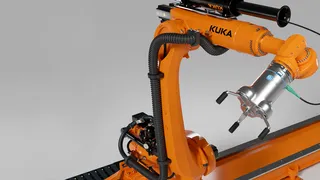
I've always been interested in technology. I bought my first computer around 1983. There are so many great computers and computer parts that it's impossible to buy everything. I have enough money to buy rice and tea, but not nearly enough for all the industrial robots I've modeled. Since they are too expensive for private use, I”m glad to at least explore them in 3D.


Otherwise, your models are very diverse. You modeled everything from insects to lab equipment. How do you choose what to model?
It’s an instinctive choice. Sometimes I also want to practice certain 3D techniques. It happens that I get bored with models, but I’m used to finishing things. I finish most of my models and sometimes my interest returns when they are done.
What is your favorite thing to model?
It varies from time to time. Mostly it's a topic, whether it's watches, robots, guitars or creatures. If you want to make a clock, you also need to create a hand, and it’s simply endless. Before AI takes away our jobs, I would like to have more models in my scenes. I just like to be creative, it makes me happy.

How long does it usually take you to finish a model?
I make a guitar in 22 working hours, including documentation and 3500 pictures film material (animation). A robot or a complete computer takes about 40 to 60 working hours. Sometimes the process is longer or shorter, depending on the level of my interest and health state. But my computer mouse never sits still for long. If you want to do things quickly, the computer mouse must also move constantly.
You offer all your amazing models and materials for free. Why is sharing so important for you?
I like to share, and I've gotten so much from the internet that I'd like to give something back. There are so many culturally valuable things that I like to share with others, even if it's just for show. I also like the story behind Blender, in which so many people came together to create great things. I want to be a part of it.
Do you have any suggestions for starting 3D artists?
Yes. When you start with Blender, definitely do the donut exercise from Blender Guru, it's a really, really awesome tutorial. Keep learning and practice, practice, practice. You never know what might come your way.

Love Joachim's work? Support him by subscribing to Full Plan. Creators of free assets also get rewarded on our platform. Read more about fair share.
Support Joachim's work