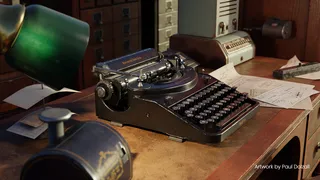
Paul Dolzall is a filmmaker with a strong passion for 3D modeling, animation, and video games. He is the creator of many remarkable historical models of furniture, accessories, office equipment, and much more. In the interview, he discusses his creative process from research to realization and all over again.
Hi Paul, will you please tell us a bit about yourself?
Hello! I live in the United States, in Connecticut. I probably first attempted to use Blender at least 15 years ago, but I began using it more consistently around 2018. Ever since then Blender has been my most time-consuming hobby.
What attracted you to Blender?
I've been interested in animation for as long as I can remember. When I was a kid, my goal in life was to be a Disney-style animator for feature films. By the time I was an adult, my interests (and abilities) had slowly shifted towards the live-action filmmaking side of things, which eventually became my primary career. But I never really lost my interest in animation, and combined with my interest in film technology, that meant I was quite interested in computer animation and CGI. Whenever I got the excuse in a small production to try to incorporate a small 3D element, I would try to teach myself how to do that.

Did your film career influence your approach to 3D modeling?
At least in terms of the type of work I am uploading to BlenderKit, I think my film career is mainly responsible for keeping my interest in animation and 3D modeling alive in a way where I just kept dabbling in it long enough that I eventually fell into a groove with Blender in an entirely different way.
Another thing I've always been quite interested in is video games. When Substance Painter first came out, I started dabbling with porting some of my models into game engines. Initially it was just an experiment, but creating game-ready props grew into an obsession for me. I've been pretty consistently creating props whenever I can in my free time ever since around the end of 2018. I've also done a small amount of work directly for games.
Much of my early modeling for games was laser-focused on maintaining ultra-low polycounts above all else. Lately, as game engines and video cards have become much more adept at handling large amounts of data, I've tried to strike a balance where my models are still game-ready and reasonably optimized, but the topology and detail are high enough that the models are, much of the time, still viable for things like architectural visualization or filmmaking purposes. Hopefully, I am being decently successful at striking this balance!
Your main focus is models of historical furniture and accessories. What intrigues you about vintage designs?
I've always been fascinated by history, and I think modeling (and the research associated with that) for me scratches a similar sort of itch as going down a Wikipedia-rabbit-hole. Usually, if I have one historical item that—for whatever reason—I've decided I want to model, by the time I've done enough research to have good documentation on what the item looks like from every angle, I've found 5 or 6 other items that are associated with it, which I also feel the need to make.
Most often the first item is simply something that I thought was visually interesting, but after doing several items, I know a lot more about how the items were made, why they were made, how they worked, etc. Sometimes that is useful for modeling other items in the future; other times it is just interesting.


Where do you find references?
My favorite way to research historical items is actually by browsing antique auction sites. Part of this is due to the sheer volume of interesting things you find on them, and part of this is for the utilitarian reason that many sellers on these sites do a good job of documenting the item they are trying to sell from multiple angles, so you aren't left trying to piece together what an item looked like from 12 different websites.
Usually if you want to know more about the actual history of a type of item, you need to then venture onto other types of research sites, but for the initial visual research, this is definitely my go-to. They aren't necessarily the best for researching props, but I'm a big fan of the amount of public-domain archival material you can find on online government sites like the Library of Congress or New York Public Library.
Which historical period is your favorite to work with?
My modeling keeps orbiting roughly the late 1800s to the 1940s; there are a lot of events and trends and objects within those years that I've always been fascinated with, but I think for modeling purposes I enjoy how flexible that time period is. There is plenty of fascinating technology and new styles and so on, but at the same time, a lot of basically ancient technology and items still feel at home.
You have uploaded to BlenderKit plenty outstanding early 1900s lamp models. What inspired the collection?
Lighting in this time-period is very confusing because there are many old lighting technologies dying out and new standards coming in, and sometimes the lights are retrofitted, and sometimes they are disguised to look like one or the other. To some extent I dread doing lights, but the number I do have is mostly just the result of my library at one point having lots of things that go indoors but no lights to illuminate them.


Beautiful antique toy models are not missing from your work either. What is the story behind them?
Toys have tended to be the type of model I make when I'm not sure what I want to tackle next and need a short-term diversion. I was pretty surprised that a couple of the toys on Blenderkit seem fairly popular in terms of downloads, so maybe I should make goofy toys more often.

What projects are you currently working on?
My most recent project revolves around the theme of office spaces from roughly the 1880s to 1940s. Other than researching when various types of equipment or types of desks arrived in offices, I think the most interesting thing was realizing that, especially outside of big cities, the very idea of "the office" was a lot more flexible back then. There are still a number of items I'd like to model for this collection once I get a bit further with uploading past assets to Blenderkit.
Why did you decide to become a Blenderkit creator?
I've been at least somewhat aware of Blenderkit for some time, but for whatever reason I never properly tried it until recently. Part of it was that my models were game-engine focused, and I thought they would be either entirely wrong for Blenderkit's library or at the very least strange outliers. But obviously the film and game-rendering worlds have been converging closer and closer. So recently I thought maybe my models would be of use in Blenderkit after all.
Obviously, I do not have any special insight into what the Blenderkit community as whole wants, but I've been very pleasantly surprised by how much use many of the models seem to be getting since they were uploaded. I've always found it a little depressing how, in the traditional way of selling 3D models, unless you upload a rare Blockbuster asset pack, most models sell few enough times that they essentially never get utilized. I'm definitely very happy to see that many of the models are likely ending up in people's renders (or games, or prototypes, etc.). There have also been a few items I uploaded on a lark, thinking they would be the most niche of niche items... only to find they are strangely popular? You never know what people might need.

Do you have any tips for emerging 3D creators?
I think that it is extremely important to always be working on something. Usually if I open Blender and make a doodle, it'll turn into something I feel the need to keep going with. Even though it's a cliche, opening the program is actually the most useful thing for me.